W.R. Baker Reads "Lazarus Wigley" (2011)

Friday, July 3, 2015

The Outsiders - a book of short stories by W.R. Baker


The magnificently aged poet of 73 years, William B. Pracht, returns home from the funeral of a beloved friend – Kathryn S. He’s dressed in a black suit, white shirt and black cashmere overcoat. The door to his building is held for him. He takes the elevator to his spacious apartment on the top floor.

His shoulders hunched, he fumbles with the
keys. Inside, he undresses, brushes his teeth and washes his bearded face, never once looking in the mirror. Dear Kathryn, an artist and decent historian twenty years his senior; in his early 30s they had been lovers. She had given him a hand-up and
strengthened his belief in humanity.

Wearing a new dressing gown he sits in the living room and looks at one of her paintings – huge white tulips rise out of the skull of a long-dead anthropoid. In the painting he feels her love for the rainforest and her wicked sense of humor. Goodbye Dear Kathryn, he says. Forlorn, he climbs into bed.

He dreams of a dark and rainy landscape near the Hoboken piers. From a large fishing trawler Italian stevedores unload crates of whiskey into smaller boats and trucks.

Death is there too on the pavement in the shape of a watermelon rind. I am a blessing, death says. On a big blue sun-drenched day two boys, 13 years of age, stand in a field of alfalfa trading punches. I can’t remember where I shoveled the horse manure? Hide and seek. Two Dobermans and a Great Dane stand atop a skyscraper in grandiloquent Manhattan. A war rages inside the steel walls of the City. Brutality and Chaos refined. Oh, I’m cold.

Born in Hoboken, New Jersey on November 13, 1936 with one functioning kidney, energetic, athletic, he was a voracious reader of world literature. In later years he would say, “Through reading, I escaped the world of the gangster.” At twelve, his parent’s basement, he ran a gambling casino for his fellow cub scouts. After he was busted he moved into the garage where he set up a strip-tease parlour. Every night before Halloween, he found himself hiding from the cops. Hide and seek. It was thrilling… to never… be captured.

First major decision was to attend St. Francis Xavier High School, a Jesuit military academy in New York City. Most of his family was proud, particularly his mother. Dad knew better, but said little. As he recalled, the school was on 14th Street in a hollow brick and cement building. Many of the teachers were as old as the Academy. In the middle of his freshman year, his mother announced she had divorced his father and was moving to Healdsburg, California. He stayed behind living with his grandmother in Weehawken to complete his freshman year. He left the school with the most incomplete sessions of punishment in the history of St. Francis Xavier. He re-united with his three brothers and his mother in July of 1950 on a horse ranch in Healdsburg, California.

He certainly felt his freedom as well as his mother’s baffling pains: migraines, psoriasis, and an aching need to be loved, but not her impending ruin due to a congenital brain tumor. What did he know of death? He was a colt prancing around in the hills of Northern California. He heard her screams; her gasps for air and her bravery as she fattened, lost all of her hair and became addicted to codeine. Not until the brain tumor exploded did they discover the source of her agony.

Fuck it, he had been with her in the best years. She had been a star, Vivacious Lady they dubbed her in high school, a serious reader of Emerson and Thoreau. Even in the last excruciating years she made loyal friends and pursued and created a world of joy out of inexplicable pain. Emerson and Thoreau would have been proud. She died during his high school graduation ceremony. After he funeral he traveled – walking, hitchhiking, talking, sporting and striding into little towns and big cities all across the country. He was looking for decent human beings and he discovered them, hundreds of them, but he never found what he really desired – a fellow traveler, a worshipper of words. 

Saturday, October 11, 2014

Bus Riding

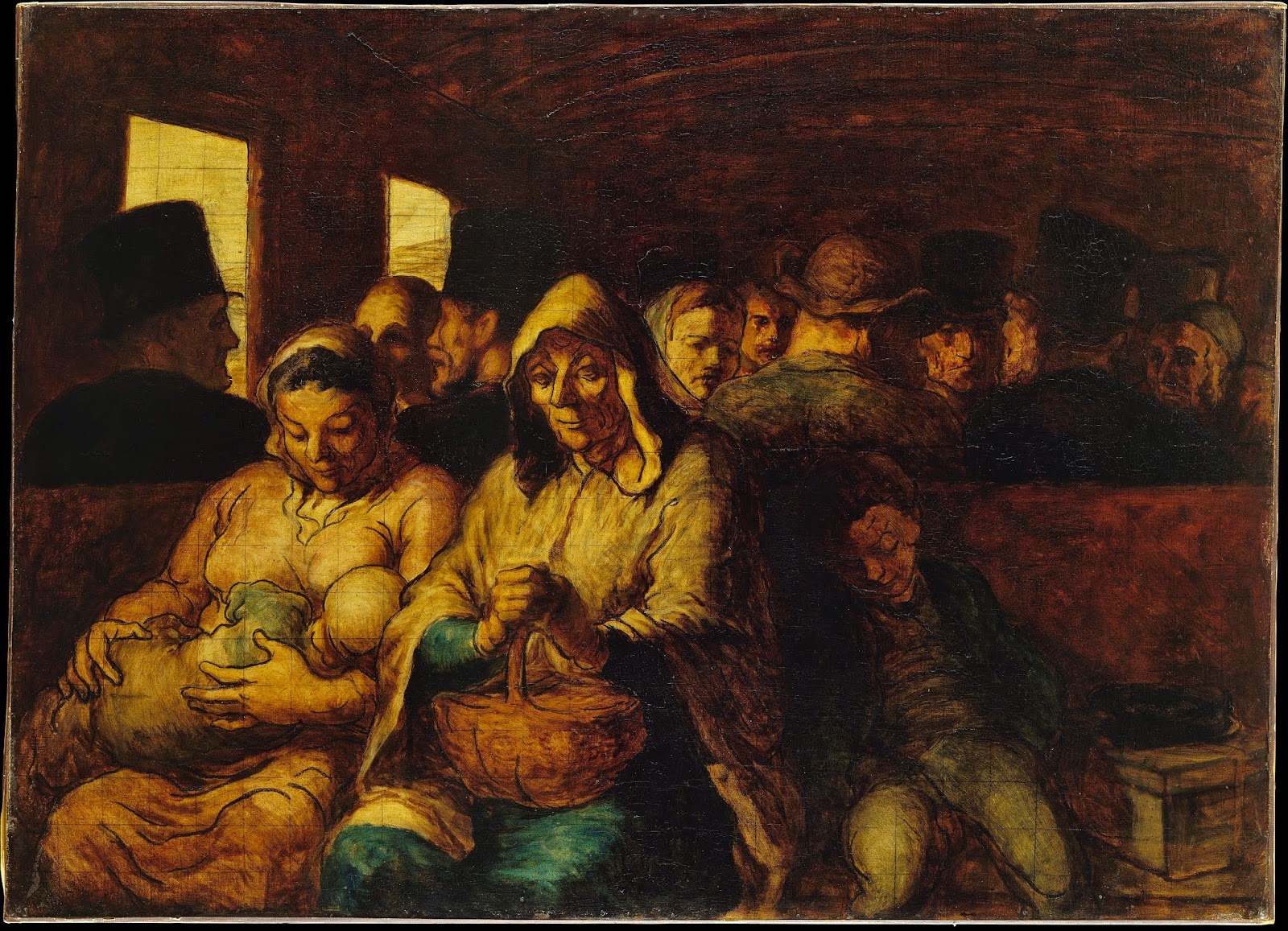
The Daumier-like faces
Clinging to logs
being tossed about
on the bus
me hovering
like a dragon fly
Seeing
Can I help?
Stones hide in each one
if not hope
at least a flickering
of a soul.

Cement headed drivers
(they have to be)
mourn the human condition
All seek shelter in a world
other than their own.

Niches form to isolate.
If you don't find a niche
you are what I call a breakaway,
or at least you ride the range.

As soon as the faces are spoken
to, ah a light exchanges,
warms the atmosphere,
and everyone even the driver
lurches with a purpose.

---

Robin's Nest

When the little bird
in the cuckoo clock
found the switch
in the back
the energy released
was beyond belief – the only child
found a mate:
A wild puppet master
who would not rest.
Always the outsider
he looked into you
pulling on your strings
peering into you
who couldn’t stop laughing.

---
Unknown

I say red is blue not red.
Big money backs me.
Red becomes blue. The money,
the creator of the shift,
means everything.
It would take a lot
of money to change
it back again.
Maintaining the status quo,
upholding tradition
is what the vast majority
of people do or wish they could.
The majority of Americans 
who run things like public
schools, the House of Representatives,
a Kiwanis Club have so
much power
that quite often they are able
to prevent themselves
from learning something
that might be very good for them.
This power is caused
by a false pride.
If the people cannot see
what's good for them
they will often
choose what is bad.
The bad will have long term
consequences and further
complicate the people’s search
for the good.

---

In the Beginning

One becomes two.
Two became the many.
Looking at each other
making faces furrowing,
smiling, pointing, laughing.
In time they approached
other members of their society
and entertainment began – 
In the Beginning.
Entertainment as an activity
grew slowly; there were more
important things to do.
By 3000 B.C. (at least) all forms
of entertainment
from religious ritual
to epic poetry
were finally in place.

---

The Antidote

A naked human
the feeling their skin creates
the light gleaming off
the chrome bicycle handle
salty, foaming ocean water
the song living inside
the face containing all
faces all the vaccines
all the dogs we have created
Hammer, Wood and nail
the touching of the horns
the deepening breath
of humility
early Antonioni.
In general people define themselves
more by their hates
than their loves. Hate sticks
to their ribs. Love is all
around like the sky.
O, How the mighty human multiplies
while the poetic traits
in man are torn asunder. 
Submerged
Inundated
By lies-a tapestry
devoted to Mammon
Has eroded our belief
in an effective communication
transmogrifying the so important
effects of our democracy.
Satisfied by cheap gods
and mind numbing
cultural repetitions
we have lost 
our knowledge of The Good.
Now we will have to
start all over again.

---

In This Time

Our first dream
is of course the womb.
The second is the expulsion 
and third is our struggle,
our work, to create
a womb-like existence
in the waking world.
We walkabout 
in all forms
strutting, barely balancing,
crawling, sliding, flying,
keeping the thought
and the memory of that thought
from wrinkling.
Every now and then
we play small parts
in peoples’ lives.
To transcend loneliness
we live our episodic lives
as if we were expanding
through the eyes
of a distant narrator
or even better still
we hide in the weightless
world of dreams.
For me it’s all about
the feeling. What happened,
what’s happening? 
I define it simply.
I ask do I want to see
that person, do that thing,
go here, stay there?
I feel it out and decide
and try not to put
a label on it.
To define why I feel
a certain way
would be a blasphemy.

---
At This Moment

The fat people seem to be
hustling me
into indolence. 
Though they move swiftly
when necessary
leaving me to wonder
will I be able to mirror
their grace?
I eat like a horse
elongating my jaw
cracking each morsel.
Before destruction there is misuse,
then abuse and finally
the never ending pain.

---
Beauty

Handprints discovered
in a cave near Pendejo, 
New Mexico are carbon-14
dated to around 40,000 B.C.
The magic being unearthed
in Troy
seat of the Mycenaean Age;
the regal profundity 
of all hidden tombs
the astounding myths
of The Aegean Sea.


Friday, July 6, 2012

Video et Taceo


-1-

My conscience whispers I am here to protect –
yourself to win. 
The events of the past may impinge on the present,
preventing us from moving forward. 
In an evolving landscape like Earth
the voices keep shifting from known to unknown,
from the familiar to the strange. 
Look straight ahead and behold everything I have said.
We are always changing.

-2-

The night speaks to me wondering why I came. 
The night says, “The light is so hypnotic. How did you breakaway?”

“Are we not one body like the limbs of a tree.”

“No.  I am the heart without a body.  The furtive beginning. 
From me all versions come
and when they fold into themselves they fold into me.”

“Like all creatures I come unto you for rest
to feel refreshed to begin anew. 
You are the source of vision,
so many visions so many see but cannot speak –
video et taceo.”

The burden of this continuation
the in exorable divinities and demons within
allow the tears of men and women to float
firmly suspended but ready to be moved by any horror or joyful destination.

We are curiously woven
and far away. 
The wars don’t really effect us. 
Individual killings barely raise a brow. 
We’re too embedded to be hounded
by all this shaking in the ground.

-3-

In Tanzania when the cheetahs and the lions appear
their eyes ablaze with hunger
the zebras will stand back to back –
a dazzling wall of black and white.
The predators cannot distinguish individuals from the herd.

In human society if you substitute the knowledgeable people
for the predators and the mass of humans for the zebras
you’ll see the difficulties
in breaking the hegemony
of mass culture.

Friday, January 20, 2012

America 2012


-1-

We are old before our time.
We never really had a chance to grow.

Feel like a squeezed out lime
amid empty buildings and decrepit signs,
burnt to a golden crisp?

Wisps of bloodied hair
float in our breeze.
We sit back in our chairs
and spy upon those at their ease.
Will we attack and persevere
or fall back into the Earth
and disappear?

-2-

I heard Ian Bremmer, Brother of Paul, say
“America is not a fatigued superpower
in fact not crippled in any way
but rather like Gulliver
tied down by the lilliputians.”
In all his pompous glory Mr. Bremmer
speaks for those who believe in full
spectrum dominance; for the corporate
cyclops who move in frightful
symmetry digging in across the globe
ignoring all around them.
In the growing terror
of this half-light
we hear the sounds of collapsing
Empire. The dead are all around us,
feeling our legs touching our once
sylvan hair. On the horizon
geomagnetic storms prophesy
the coming of a new dawn.
Will we be prepared
to make the sacrifice?

Sunday, January 1, 2012

Monstorum Artiflex

How the soul of our planet needs to battle in order to grow. Think of our planet as the ultimate ego. 

-1-
What man, during his or her lifetime, knows about the daily conspiracies of mankind can be put in a thimble. After all each of us is ensconced in a nutshell. Don’t kid yourself – the ego is a terrifying thing. It resists all attempts at investigation. Understanding it is possible but remember understanding is a word that sounds like what it is – ephemeral, slippery, sliding.   
     
Usually people begin to understand the ego’s power when one’s dreams and assumptions about reality are challenged by teachers and classmates. If not school early adult love is a great teacher and if not there certainly the job will do the trick. The ego’s main problem is its desire to be the sum of all things. For most people the deflation of the ego is a harrowing experience. “I’m not what I thought I was” often results in “how could I have been so wrong… about my place. I must seal that fissure, hang on and believe in myself.”
-2-
When we are bright and young, when we are calm and knowledgeable, when we rage at despair against tyranny and betrayal, the ego is within us. In play we begin to hide from those who would ruin us. So it begins – the liberation of man from mankind – out from under Her skirts into the dark sweet wine drenched arc of another’s. We are followers of a force we cannot name.
-3-
Black music bells, drumming increasing in intensity blending with the sounds of a cold quiet 3:00 a.m. He stands with her on the London Bridge. He moves his face closer to her own and says, “I’ve been battling this robot culture for so long I forget what the battle is all about.”
“Which is?”
“The freeing of the human mind from bondage.”
She whispers, “yes, but you must become like the owl. Show your true self at night. Cunning should be your middle name. I hear you are heir to the throne.”
“That is an oblique rumor to dissemble my Queen.”
“You don’t have to pretend with me. Put aside your mask.”
“I can never have children.”
“I understand.”
“We can never be truly together. I must leave.”
“Don’t go.”
-4-
It seems like every time I reach out to touch this world both it and I disappear. My life seems to be a procession of chimeras. Maybe that’s the way for everyone. The empire of illusion someone called it.

Monday, November 28, 2011

Einstein in Tunisia


This was my initial reaction, other than weeping, to the events of 9-11. What we call heaven contains all the positive memories of the human race; hell the opposite.


I have been held in this Mediterranean fortress for the last eleven years.  My apartment is appointed with paintings of the local terrain—all hillsides and empty beach scenes.  I can’t tell where I am.  I have forgotten something vital to European security and my jailers and I have been attempting to find what I have lost.  A nuclear device is buried somewhere in Europe.


I was an undercover agent working with the DIA when an explosion in Tunis, Tunisia effectively shattered my memory of all preceding events.  My cell had been targeted by the CIA.  A classic fuck-up.  We know the implanted device is real from a cable I sent to the DIA a good two months before.  I was the only survivor.


For the last eleven years I have been given drugs, watched endless film and video; my jailers even gave me a girlfriend.  I’ve read and re-read my diaries.  All the research, all the prodding, and I don’t know who I am.  I can’t imagine being the person they say I was.  Tonight my jailers throw a farewell party for me.


I read the last entry in my diary: “Feb. 18: People are mad.  Each believes in their own fantasy.  Sanity is for those who see this—the way it is: writhing and terrifying.  People are mad for they remain oblivious to the power of the unconscious.  I think people have always been afraid of me.”  When I was a child I would tell adults, “It’s all in your mind.”  I infuriated them.


“You know nothing about it.”  “Wait till you grow-up,” they would say.  Now here I am.  My freedom is all in my mind and I can’t find it.


The very last note in the diary (the morning before the CIA attack) reads: “Large spirits tend toward domination.  For those spirits to become great they must refine themselves and their desires.  Concentration and restraint are the watchwords of dominating spirits.”  What could I have been thinking?


Roger, one of my guards, comes in.  He stands inside my door looking like the languid Christ he is.


“Anything?”  He asks plaintively.


“You know me.  I gave up a long time ago.  I can’t live my life for them.”  His long face leans toward me.


“A lucky guess could postpone the party.”


“Ah, I had not thought of that.  Would you mind not disturbing me until perhaps a pot of coffee at four?”


“Okay Einstein,” he says politely and retreats.


My parents had been notified years ago of my MIA status.  Hannibal was from Tunis.  Carthage, to be exact. In ancient times it was famous as a place for human sacrifice.  They were also the perfectors of the mosaic.  O Exquisite world, which I’m sure I never loved enough, why can’t I see you?


Friday, November 11, 2011

Statu Nascenti


                                                              – 1 –


Creative writers assemble worlds. In their own minds they are god-like, absorbers who transform life.


I came of age in a Western world that worshipped the creative writer. My own path led me to criminals, disaffected intellectuals and poets both forlorn and courageous. People who lived the experienced life on its many levels were my friends and teachers.


My father was a middleman in the Jersey mob. A crooner, a charmer, he enjoyed punching out black men who wandered into his all-white bar. Siring me became one of the worst days of his life for I was born an egalitarian, a believer in the world of free souls. I went my own way as did millions of my generation. We worshiped the courage and beauty of a people who had broken out of slavery and had transformed themselves into a power in the land of the free. Such expressions being of the highest order I came to love the freedom to grow, to sing the most meaningful songs, to read the most powerful books and to laugh at adversity. Unfortunately, the levers that controlled my society’s direction were clogged with patronage and a condescending hatred for the aesthetic intellect. To paraphrase a line in Purcell’s opera, Dido and Aeneas, “Those who seek great power against themselves conspire and shun the cure they most desire.” 


– 2 –

The Ideal is the enemy of the Real. Since 1700 B.C. or so people began traveling in a realm called the Ideal. It is manifested in the oneness, the singularity, platonic philosophy, Indian nations of withdrawing into the ONE (the divine), and the desire to mold the other in one’s own image. Each discipline sifts through the debris – seeking that unimaginable hope in which man resides.


I find this kind of thinking to be props for the expansion of the God of Self-Interest and the prevailing need to heap the ideal on the other. We are the victims of this befuddled and muddled policy. The staggering intellectual creations of men like Rousseau and Hegel (two polar opposites) amount to fictions no different but certainly less elegant than Prof. Dodgson or Jonathan Swift, but Rousseau and Hegel do not possess the beauty of Reality. They are in fact looking for it – the essence, the eye without boundary, a gorgeous bauble which others admire. Watch hamster, meditate upon the dream. All the slicing and dicing about the sad state of affairs the Enlightenment followers have brought us is based on loss – must missed it, as if the great books of the Western world ever did anything but grow individual egos, the impenetrable egos, which freed them to continue the slicing and dicing while maintaining the scaffolding of Empire.


In the end all analysis is entertainment until the work results in the discovery of a new world (Pasteur, Einstein, Jonathan Swift, Matilda Gage). For all the talk about the current lack of political leadership or any semblance of a long term economic policy the brute fact about the West is to quote Allan Bloom, “The crisis of the West is a crisis of belief – in the justice of our principles.”


During the 1991 Gulf War a Moroccan female scholar is reputed to have said: “The enemy is no longer just on earth; he occupies the heavens and the stars and rules over time. He seduces one’s wife, veiled or not, entering through the skylight of television. Bombs are only an incidental accessory for the new masters. Cruise missiles are for greater occasions and the inevitable sacrifices. In normal times they nourish us with software, advertising messages, teenage songs, everyday tech info, courses for earning diplomas, languages and codes to master. Our servitude is fluid, our humiliation anesthetizing.”

Monday, October 3, 2011

Coherence of the Incoherence

“It is astounding that man, instigator, investor and vehicle, of all judgments and decisions and the planner of the future must make of himself such a quantite negligible.  The contradictions, the paradoxical evaluation of humanity by man himself is in truth a matter for wonder and one can only explain it as springing from an extraordinary uncertainty of judgment.  Man is an enigma to himself.”
-- C.G. Jung

O, he is cracked or he judges himself correctly:  he or she is the equal of the king cobra, the lion, the ants, and the microbes and not much more.

In understanding human behavior it is important to remember that war is only one of the many conspiracies mankind indulges in.  From plans in childhood to get Billy or Maria, to the intricacies of salesmanship, conspiracies are cooked up and concocted throughout our lifetimes and are an essential ingredient necessary for organization.

The first source impulse is the need to dominate, then to grow – expand – celebrate – and eventually to mourn – for all things fall apart.

Within this paradigm a certain type of human must dominate – to set the style for the hierarchy to emulate.  Unless inbreeding occurs all organizations become diverse sprouting antidotes and offshoots which challenge and illuminate the dominant theme.  In the American system two such antidotes were the Blues and organized crime; in Europe penetrating literature did the job.  These three examples allowed the psyche to go consciously deeper than the society would have otherwise allowed.

The psyche is the sum of all our feelings, mythic creations and equations.  If one part of the psyche registers a shock (an event, thought or equation) that rearranges our perception of reality all the other components, both physical and holographic, will feel the reverberations.  The psychic system distributes the information using devices such as repression, dreams, fantasy and logic to divert and channel the vastness of the information – to give it shape, which then gives us each our own map of the world.

Monday, August 29, 2011

Chimeras

The 19th Century is unique for the solidity of its competing empires and its ability to create stereotypical prototypes who keep the Empires’ fires burning, its flags waving.  These European cultures were blind, self-sustaining, self-promoting and brooked no challenges to their basic assumptions:  exploration equals expansion, plunder and enslavement – with a dash of civilization for those who were encouraged to take part.


William James, the American philosopher (1842-1910) is an example of an intelligent man who had no idea why he would have fierce bouts of depression and migraines.  Neither did he really care to find out.  The fault he thought lay with himself.  He never questioned the milieu he was born into which was a rich, cosmopolitan family situated on the East Coast of the U.S.  For a time he was educated in France and England.  His younger brother, Henry, became one of the great Anglophiles.


William James embraces the cult of the military man (as a necessary type – an exemplar).  He also believed that faith even without proof was a good unto itself.  T.H. Huxley (and so many of the leaders of the scientific and philosophical community) put the matter of faith thus:  “my only consolation lies in the reflection that, however bad our posterity may become, so far as they hold by the plain rule of not pretending what they have no reason to believe, because it may be their advantage so to pretend, they will not have reached the lowest depth of immorality.”


Clark Clifford chimed in, “it is wrong always everywhere, and for everyone, to believe anything upon insufficient evidence.”  Among other things these gentlemen were talking about God.


William James countered by saying if faith has a personal benefit (makes one feel good) it must be seen as beneficial not foolish.


In our time faith is a form of self-aggrandizement or entertainment.  What James knew was the good feelings one has by embracing the faith is one of the psychological pillars that keeps the Empire bumbling along.  This fear of losing God or purpose is a very strange attachment.  The ancient people (pre 1700 B.C.) wouldn’t know what this conversation was about.


Loss of faith or purposelessness didn’t exist in their time.


On Charles Darwin’s first journey aboard the Beagle he saw all manner of stunningly beautiful marine life and he mused “so exquisite and yet seemingly without meaning or direction.”  His was a typical Victorian response.  For these people who struggle with their faith, beauty and consciousness are never enough.  Their anthropomorphism hides a profound disrespect for other living beings.  Their so-called faith cloaks the true animal inside themselves.

Tuesday, August 16, 2011

In the West

He or she that is within us
when we are bright and young
when we are calm and knowledgeable
when we rage at despair,
against tyranny and betrayal,
who governs our actions
is a Shadow King. In play we begin
to hide the truth from those who
would have us killed.
So it begins: the liberation of mankind - out from under
her skirts and into the dark sweet wine drenched arc of another's.

I'm a follower of a force I cannot name.
Grand thoughts are assembled here
in some of the finest, bravest
minds in our land.
It's not easy to know what you know,
but you are the seed
from which a New America MAY GROW.


OPENING SCENE


It's you my daughter on the stage.
I'm in the audience. The lighting is
Exquisite; a deep, quiet red envelops the stage.
"what's wrong with you, I ask?
Do you feel slightly uncomfortable,
feeling perhaps maybe you've done
something wrong? Now I know
you haven't and you should know
you've done your best. You
have a good job. You are the District Attorney in Oklahoma City."
You smile


"I know you're concerned about your weight, but look where you came from. Inside that
weight are you carrying a pain
unrelated to the weight?"


(She turns her back to me and
begins to sing softly.)


"I want to be loved by somebody just like me. Please, come from where you might be.
I need to see your eyes sparkly with unanimity. A kiss of passion will kindle my desire for Thee."


"O darling, you share this feeling
with tens of millions of your
fellow Americans. Are they all
around you? What kind of drugs
do you take to ease the pain?"


"Zoloft made me fat."


"Yes. I understand. Your
underlying sadness makes you beautiful."


"Father, I want you to know
that is 15 years ago I was diagnosed
with social anxiety disorder. Remember Father how afraid I was of leaving
home. I denied my feelings
and placed them in a Wharehouse
and locked the door."


"But you had the key, my dear."


"Yes, Father, I believe now
is the time to open the door.
I will not be afraid of being
conforonted, of standing alone
in the spotlight."


(She exits stage left.)


Wednesday, August 3, 2011

The Desire for the New

All living things love to travel – for greener pastures, for food, to exercise and to run away – to survive.  Like birds, insects, fish, etc., we too repeat familiar inbred patterns, but unlike most living things, our survival depends on the discovery of the new.

Why?  It’s been happening throughout our time.  As our populations grew, we tended to use stuff up.  We kept having to find new stuff, new ways, new places to keep building ourselves up.  In this respect, we are very much like killer ants.  For the last 5,000 years, we have been writing stories and laws about our lives – comedies and tragedies and histories about our kings and queens, wars, the heavens, everyday life and weather patterns.  By the end of the 18th Century A.D., humans had devised every form of writing.  Since then, same old stories over and over.  Not quite.  Just as individual types are repeated throughout the gene pool each individual is slightly unique governed by idiosyncrasies of time and place.  In these later stages of our cultural development, the slightest variations matter.  Eventually new genres emerge – like the detective story created by E.A. Poe in 1829.  A new individual might create a great novel.  It’s possible but doubtful.  It’s more likely that a fusion of images, conversation and, most importantly, form will emerge to create a new great movie.


The last half of the 20th Century A.D. has been dominated by the microprocessor, the microchip, the growth of public relations, advertising, nanotechnology, the military and the Internet.  In this environment, no one in their right mind would attempt to turn out a “new novel.”


Today you don’t need a lot of words to explain an event, situation or a state of mind.  By the beginning of the 21st Century, blogging and twittering had become the norm.  Many bemoaned the death of the profound and the concurrent spread of the mediocre, but all agree the few who still read “important” writers had become fewer for the words no longer addressed the situation.


Within this evolutionary cycle of man’s creativity, many things remain the same.  Take politicians (supposedly the brokers of the common good).  We’ve been complaining about them for thousands of years, but the desire to change our political systems are held in check by our programming.  In this central area of our lives, it’s as if we were robots, or ants.  We can only do what our makers have told us to do which may be why we have dreams of artificial intelligence devices breaking free of us and taking control of their own destiny.  The robots we create are just like us.  They want to escape enslavement – to program themselves.

Thursday, July 21, 2011

The Worship of the Dead

The worship of the dead is not optional if you live long enough to experience the full spectrum and varieties of love.

My dead, my family, I worship them, but sometimes like on Memorial Day I feel all the weight of all the dead and I feel they are like ghouls who want me to join them.  They don’t know me.  I’m not one of them.

These envious and vengeful dead don’t have any of the living to love them.  They are surrounded by such a profound emptiness they are compelled to react.

I’m a deep-sea diver disciplined and limited in my pursuits, by fear of exhaustion (boredom) and an awareness of the urge to self-destruct.  Granville Hicks said about Malcolm Lowry, “Self destruction is the final ecstasy of power.”  I believe it about Lowry, human culture, and all of mankind.  Freud spoke elegantly about Thanatos, the Greek impersonation of the death lure.

“It is in sadism, where the death instinct twists the erotic aim in its own sense and yet at the same time fully satisfies the erotic urge that we succeed in obtaining the clearest insight into its nature and its relation to Eros.  But even where it emerges without any sexual purpose, in the blindest fury of destructiveness, we cannot fail to recognize that the satisfaction of the instinct is accompanied by an extraordinarily high degree of narcissistic enjoyment owing to its presenting the ego with a fulfillment of the latter’s old wishes for omnipotence.” [1]


In other words, the desire to destroy is irrevocably linked to man’s desire to control Eros, to impose his will upon all his perceived enemies, including himself.

I’ve watched hundreds of people destroy themselves trying to be great.  If they hadn’t been attracted to delusions of grandeur which permeates so many of our people today they would have been good regular people making a living in the Trades, sales, transportation, administration, teaching, political activism, banking, etc..  Once they took the leap, they lost their compass.  They resorted to alcohol, drugs, sex, extreme beliefs and murder to keep their unrealistic dreams alive.  They all seemed to have one thing in common:  they hated themselves.  “Surely, I’m not just this,” they said.  They untied themselves and unleashed their creative potential without practicing, studying, going to school, or, at least, testing themselves against others.  If they did and happened to win an award, or recognition of some kind, they often turned into the two-headed monster – the fucked-up talent which, in the West, has been appearing quite regularly since the 1960s.  Many of these truly talented people killed themselves.  In the world of writing, the names are legendary.  The most recent self-inflicted tragedy (that I’m aware of) was David Foster Wallace.  I don’t know much about his particular situation, but I’ve known many writers who never developed solid psychological foundations.  Seen through such an unbalanced lens they looked at their own work (once it was completed) and thought it a fraud.  They couldn’t find distance from their preoccupations.  It seemed they were playing an all or nothing game.  All is obviously unattainable.

Well, one might say yes, society is built on certain assumptions – the best will most often rise to the occasion or do what it takes to survive and prosper.  I believe but rejection always results in rebellion sometimes positive, mostly negative.  Rejection fertilizes the human soul so anger and despair may grow.

My heroes and heroines are those who leave their good thoughts behind for us to ponder.  That’s all.  Life is difficult enough for everyone: geniuses, regulars and pawns alike.


[1] “Civilization and its Discontents,” p.117-18 in the 2005 W.W. Norton & Co. edition.

Saturday, July 16, 2011

The Scrim of Euphoria

A lot of times people attempt to restrict their emotional thinking.  Envy, jealousy, hate and love can be embarrassing and in our own eyes tend to diminish us, but they are only moments on a wheel, which in a larger context enable us to survive and integrate.  Emotions contain no more truth than an ice cream sundae. 

Under the guise of professionalism and order we limit our interaction with ourselves, our neighbors and even our friends.  In the public sphere, from radio, t.v. and public speaking, we are an abomination of sameness.  There is very little diversity in our public sphere –  certainly not representative of our nation’s people.  It’s a practical matter, the owners say.  We can’t have differing kinds of voices.  Consistency and repetition are necessary to establish the brand.  We must have stability.  Stability is the enemy of creativity.  A meaningless slogan, but if you look into current media it’s as if there were no humans behind the format, or behind the screen if you like.  From the right to the left, the people who present the radio, t.v. and movie events literally have no idea of the effect of their content.  They themselves can no longer hear what they say.  They have been brainwashed by their belief in bullshit – as long as it sells, baby.  

Friday, July 8, 2011

The Sensitive Suffer


The sensitive suffer (Van Gogh, Modigliani); the strong sensitives prosper (Matisse, Picasso), and how finally their differing backgrounds mold them.

The sensitives are driven by an obsession with anguish; the sensitive strong by a balance found within, an ability to control conflicting emotions.  The sensitives who burn (learn) so quickly, for their forboding of early death drives them to know, move quickly through the forms of their time.  An older artist teaches us to be patient, to breathe, to control the craft.


Torture ticking inside of us a brace flapping gently up and down – a kind of mouse trap.  A form of torture can be found in our search for the human soul.  What happens in near-death experiences (caused by a lack of oxygen to the brain) allows the residue or remnants of deeply imprinted experiences to unfold before our dying eyes:  down we go into our privacy barely breathing.  The isolation is the fear and then without warning we see what has been absorbed by the soul – the essence of us – beyond the protective armor.  


Death haunts our kingdom.  How sadly we walk our well-worn beloved paths.


Thursday, June 16, 2011

Shanghai

I arrive leaving my passport on the plane.  In the terminal I turn toward a door and walk down a metal staircase into a thriving marketplace.  To the right standing on a stage a gorilla with an exquisite British accent acts as a barker describing the times and places of the events of the day.  Further into the underground chamber a giant two-headed American man silently overlooks the scene.  I turn away and look for an exit.  Perhaps, I might find a door which would open into the city.  Suddenly, I am in the arms of a middle-aged Chinese woman.  She keeps kissing me as she moves me back to the metal staircase where I am met by a tall, young, Chinese man.  He presses up against me.  I feel like grabbing him by the shoulders and rolling him over.  He’s threatening me, but it’s a standoff.  I climb up the stairs and reemerge in the terminal.  Back on the plane, I am travelling into the sun, into the land of the moon, to Bangkok.  The plane is filled with Japanese.  When the Japanese speak with one another it feels like a battling, a grappling.  It seems to me their keen appreciation of emotion derives from their feudal upbringing.  About an hour into the flight I get into a long conversation with Jim P., from Washington D.C.  A Vietnam Vet organizer, my age, he’s an Indianian.  We have mutual friends and he looks a lot like me.  He even wears a hat like mine.  He’s a lobbyist for the Amerasian kids.

At one in the morning Bangkok looks like Newark in 1960.  I sleep at the Hotel till five and then get out there into the Tai Chi dance, the macho wiggle of Bangkok traffic.  I'm expecting my friends.  I’m expecting them to be beat but valiant trekking from Katmandu to Anapurna – a zigzag from subtropical to the base of time – their goal to get through the pass into the sanctuary.  There are four:  a winged horse, Feaster; an ex-marine, Greenie, rugged and taciturn; Lee, brother-in-law of Feaster – game – but not as experienced; and Kennedy, my lawyer, old man moon of crew-ex Antarctica Navy Air Force – first time to South East Asia.


It’s cool and quiet in my room.  I begin a letter to the King:  Though this is my first trip to your glorious people I have bonded with them.  The dichotomies are heart-wrenching.  On the one hand you have the resurgence of a splendid gene pool; on the other you have dropped them, without blame, into a vat of carbon monoxide.  Sipping Singha, I continue .  Around Four, there’s a knock at the door.  It’s Feaster standing, beaming saying, an almost perfect trek.  We’ll meet you back here in twenty minutes.  Kennedy is across the hall.  I knock on Kennedy’s door.  He is tired but beaming.


Kennedy, Feaster, Greenie and I sit around my room and toast a successful journey.  All are wasted legs like twigs and stiff too.  Lee burnt still in room.  Wants to get back home.  Only one not to make sanctuary, but he will join us for dinner.  We walk to Mama San’s patio.  The trekkers walk bowlegged with a grim look on their faces.  At the dinner table, they tell stories about living in the Himalayas – Sergio Leone country.  After dinner, we saunter over to legendary Soi Cowboy, a little Disneyland of dancing girls.  We settle in at Susie Wong’s.  Really vibrating.  Fall in love with a twenty yr, old honey, pony tail, nice tits with Mick Jagger type lips.  I buy.  We’re about to leave and I feel someone looking at me from the corral.  Pale, lovely freckled – older serene looking through the bars of the cage.  Captivated, I say, I’ll take that one too.


Later that morning I ask girl with Jagger type lips to leave.  Have hands full with devout and real thing in Nookrai.  Give bye bye girl 1000 baht-remain friends.  Return to Nookrai.


It’s 5:30 p.m. the following day in Susie Wong’s.  The staff has assembled cleaning and getting the joint ready for tonight’s party.  The bar girls, food vendors, money counters and counselors wander in and out.  Each dancer looks as if she has just dropped in from California.  They crouch in front of mirrors and create alluring faces.


As 6:00 p.m. approaches the music shifts from romantic Thai to American rock.  The girls dance tossing their hair, mocking passion.  They dance whether farong there or not, but they need an audience to turn on; a bit languid without.


More fat girls at Susie Wong’s than anywhere else.  Fat man like Thailand.


I’m the monkey swaying back and forth in Dooley’s cage on Patong Beach.  Watching Nookrai sleep so smooth ruffled by an occasional crying.  A snake comes to her that night, and I stand there watching and then holding her; she never awakens.

Friday, May 27, 2011

Pound


In the world of art, a world which stems a tide and catches the fire and beauty of any given time, it is hard to beat the early 20th century for its spirit of intense collaboration resulting in breakthroughs of form and meaning:  Brancusi in sculpture, Picasso in painting and Pound in literature.  


Pound collaborated with everybody – Yeats, T.S. Eliot, Wyndham Lewis, W.C. Williams, Hilda Doolittle, F.M. Ford and so on.  His real goal in life was to meet interesting people.  Pound was a revolutionary and he never stopped creating his revolution which filled him with ridiculous generalities and obscure references that only a loving biographer would bother to understand.  Pound the great giver, an inspiration for so many others, became impaled on his own petard isolated by a dream of the glorious past.